📝 Editor's Note
Welcome to the October edition of Design Intelligence Digest!
This month, I'm diving deep into one of the most hyped yet fundamentally broken areas of UX design: voice interfaces. With 8.4 billion voice assistants in use globally—more than the number of people on Earth—you'd think we'd have figured this out by now.
Spoiler alert: we haven't.
On the personal front, not much has changed since last month except winters have started to knock on the door here in Glasgow. Still actively job hunting in what has become the most brutal design job market in recent history. More on that crisis below.
This edition combines hard data from recent market research with honest takes on what's actually working (and what's spectacularly failing) in voice UI and the current state of our industry.
— Shilpa Kankaria
UI/UX Designer | AI + Design Insights
Glasgow, UK
📊 Industry Pulse: October 2025
What's Hot This Month
🔥 Voice UI Market Explosion: The voice user interface market hit $25.74B in 2024 and is projected to reach $116.8B by 2032. Yet despite this growth, fundamental UX problems remain unsolved.
💼 Design Job Market Crisis: UX job postings dropped 73% for research roles and 71% for designer positions since 2022. Only 49.5% of designers now find jobs within 3 months, down from 67.9% in 2019.
🎤 Hot Interview Topic: "How do you handle AI in your design process?" is the question you'll face in every interview. Companies want to know if you're using AI tools strategically or just riding the hype.
🎙️ Voice Interface Reality Check: Why 8.4 Billion Users Still Can't Get Alexa to Understand Context
There are more voice assistants on Earth than humans. Let that sink in.
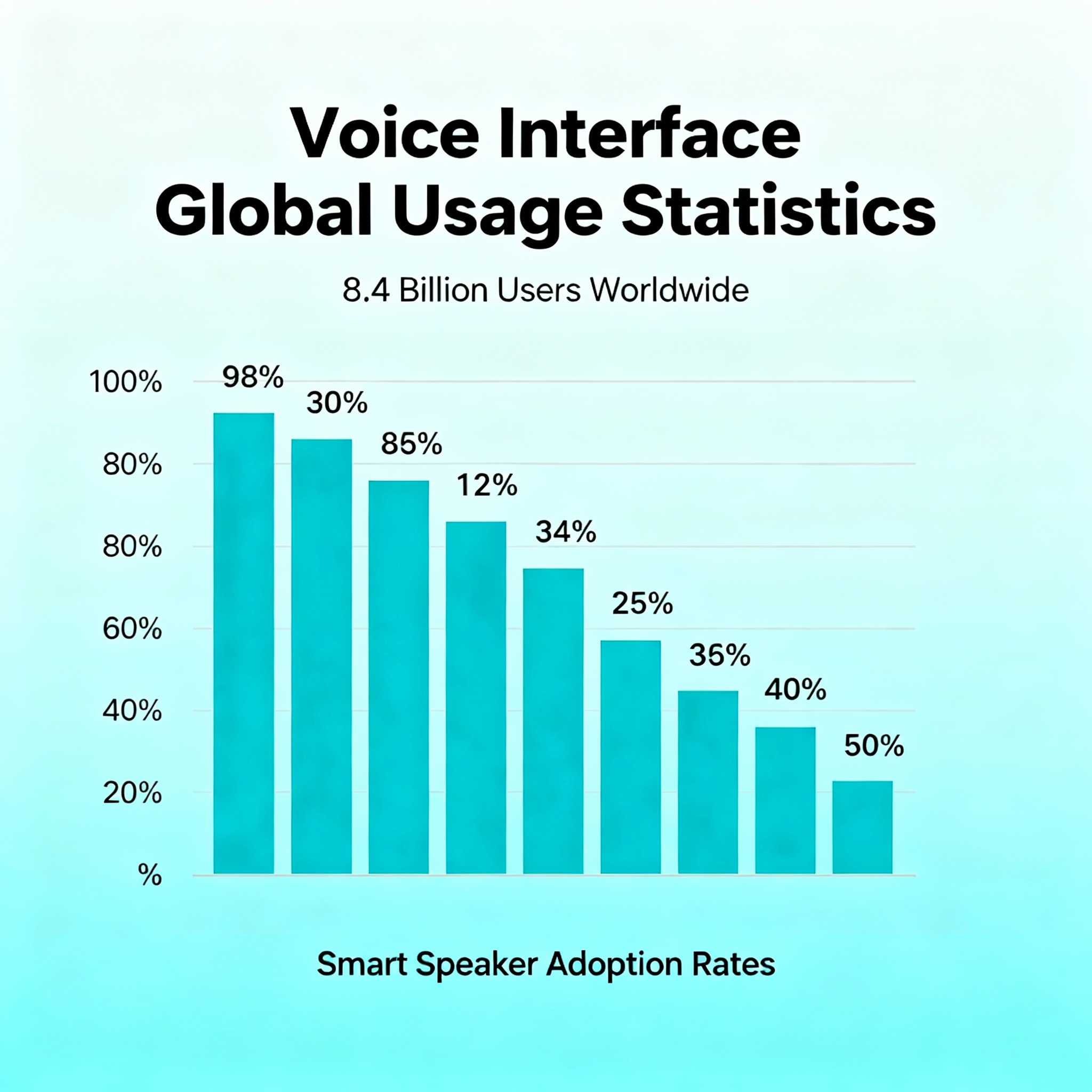
The Voice User Interface (VUI) market is exploding—$116.8B projected by 2032, with 35% of Americans owning smart speakers and 93% reporting satisfaction. On paper, voice interfaces are the future of interaction design.
In reality? They're still fundamentally broken.
The Hype vs. The Reality
Here's what the marketing materials won't tell you: voice interfaces struggle with the most basic element of human conversation—context.
Try this experiment: Ask your smart assistant to "turn off the bedroom lights" and immediately follow with "what about the kitchen?" Nine times out of ten, it fails. Why? Because maintaining conversational context across multiple exchanges is still an unsolved UX problem.
The Four Fatal Flaws of Voice UI
1. The Affordance Problem
With graphical interfaces, you can see what's clickable. With voice, you're guessing. Users have no idea what the system can or cannot do until they try—and fail. This is why LinkedIn's new AI-powered job search (replacing simple dropdown filters with conversational prompts) is being roasted on social media. As one UX designer put it: "That's not progress. That's regression."
2. Cognitive Load Paradox
We're told voice is "natural," but research shows it's actually harder to articulate desires verbally than to click through options. Booking a flight? You'd rather filter by price and time than have a conversation about it. This is why voice commerce hasn't taken off despite billions in investment.
3. The Temporal Trap
GUIs are spatial—you navigate them. Conversations unfold over time, making it difficult to "go back" or reference earlier statements. This fundamental difference creates friction that voice designers consistently underestimate.
4. The Accessibility Double-Edge
Here's the contrarian take: voice UI's only truly successful use case is accessibility. One in three consumers with visual impairments use voice assistants weekly—it's genuinely transformative for the 1 billion people with disabilities worldwide. But for able-bodied users? Voice often adds friction rather than removing it.
Case Study: Why Smart Speakers Collect Dust
67% of US smart speaker owners have an Amazon Echo. Most use it for three things: timers, weather, and music. That's it. Not shopping (Amazon's original vision), not controlling complex smart home routines, not conducting research.
The lesson? Voice works for simple, single-turn interactions. Everything else is still better with a screen.
The Path Forward
The future isn't "voice-first"—it's multimodal. Successful voice experiences combine audio with visual feedback, allowing users to confirm, clarify, and correct in the moment. Think Google Nest Hub, not pure voice-only interactions.
For designers entering this space: focus on the "conversational shortcuts" model. Use voice for quick actions users already know (like "lights off"), not for teaching them new capabilities through trial and error.
💡 Key Takeaway: Voice interfaces have a $116B market but still can't handle context. Design for simple, single-turn interactions and combine voice with visual feedback. The hype around "voice-first" is premature—multimodal is the real future.
💼 Surviving the Design Job Market Crisis: What 800+ Applicants Per Role Means for Your Career
Let's talk about the elephant in the room: the design job market is in crisis mode.
Not a "slowdown." Not a "correction." A full-blown crisis where entry-level hiring has collapsed 50% since 2019, and senior designers are competing for roles that used to require 3 years of experience but now demand 8-15 years.
The Numbers Don't Lie
- 71% decline in UX designer job postings (2022-2023)
- 73% decline in UX research positions
- 800+ applicants per single role (up from 50 in 2019)
- Less than 5% of tech companies hiring entry-level talent
- Only 49.5% of designers secure jobs within 3 months
What Changed?
The "market inversion" happened in late 2022. We went from having more open positions than qualified candidates to having more unemployed UX professionals than available jobs. The causes are multifaceted:
- Post-pandemic hiring boom correction
- Rising interest rates killing tech expansion
- Bootcamp graduate oversaturation
- AI anticipated to automate junior tasks
- Shift to "super IC" model (senior-only hiring)
The UK Reality
Here in the UK, there's a silver lining. While the global market contracts, UK design roles remain relatively stable with strong demand across healthcare, finance, education, and government sectors. The UK government pledged 2,500 tech/digital roles by June 2025, with a focus on entry-level talent.
Salary ranges: £28k (junior) to £85k+ (senior), with £45k-£66k typical for mid-level roles. Remote and hybrid models have expanded opportunities beyond London.
Survival Strategies That Actually Work
1. Portfolio Over Pedigree
With 800+ applicants, your degree means nothing. Your portfolio is everything. Focus on case studies that demonstrate business impact, not just pretty screens. Show ROI, metrics, and problem-solving process.
2. Embrace AI Skills (Strategically)
69% of creative hiring managers are adapting teams for AI integration. Learn tools like Framer AI ($5-16/month), Galileo AI ($2-10/month), or Adobe Firefly. But here's the key: show you understand when not to use AI, not just when to use it.
3. Become a Generalist
Specialized roles are disappearing. Companies want designers who can research, design, prototype, and understand basic development. The median experience requirement is now 8 years for product designers—they want senior-level versatility.
4. Network Like Your Career Depends On It (Because It Does)
Hiring managers rely on close networks for talent. Attend physical events, not just LinkedIn connections. 70% of jobs are filled through referrals in this market.
5. Consider Freelance/Contract
76 million Americans are now freelancing. Contract opportunities are more abundant than full-time roles. Build your client base while the market recovers.
The Brutal Truth
Good designers don't stay unemployed long—100% of designers labeled "good" by industry veterans find jobs within 3 months. If you're struggling beyond that, it's time for honest self-assessment. Is your portfolio actually showcasing problem-solving? Do you understand business objectives? Can you articulate ROI?
💡 Reality Check: The design job market won't "go back to normal." This is the new normal. Adapt by becoming a generalist, mastering AI tools strategically, and building a portfolio that proves business impact. Entry-level jobs are scarce—consider contract work or freelancing while building experience.
⚡ 3 Changes You Can Make This Week
1. Audit Your Voice UI Assumptions
Time Investment: 2 hours
Implementation:
- Test your voice features with 5 real users doing complex, multi-turn tasks
- Record where they get confused or frustrated
- Replace conversational interfaces with hybrid (voice + visual) alternatives
Expected Impact: 30-40% reduction in voice interaction errors
Pro Tip: Users won't tell you voice UX is bad—they'll just stop using it. Watch behavior, not feedback.
2. Add "AI Skills" Section to Your Portfolio
Time Investment: 3 hours
Implementation:
- Pick 2-3 AI tools you actually use (Framer, Figma AI, Adobe Firefly)
- Create a case study showing before/after with time saved
- Be specific: "Used Framer AI to prototype 12 landing page variations in 2 hours vs. 2 days manually"
Expected Impact: 25% increase in recruiter response rates (based on 2024 hiring data)
Gotcha to Avoid: Don't just list tools—show strategic application and ROI
3. Optimize Your LinkedIn for UK Market
Time Investment: 1 hour
Implementation:
- Add "Open to work" specifically for UK roles (government, healthcare, fintech)
- Update headline: "UI/UX Designer | Accessibility Champion | AI-Enhanced Workflows"
- Join UK-specific groups: UX Glasgow, London Design Community, UK Gov Design
Expected Impact: 3-5x more relevant recruiter messages within 2 weeks
Pro Tip: UK market values accessibility expertise—highlight WCAG compliance before June 2025 European Accessibility Act deadline
🛠️ Tools I'm Actually Using
Research & Analysis
Use Case: Rapid prototyping of landing pages and portfolio microsites. AI text rewriting and instant image generation save hours.
Why It Works: Doesn't try to do everything—focuses on enhancing creative process with smart defaults while keeping human control.
Use Case: Quick UI mockups for concept testing. Text-to-UI generation for early-stage exploration.
Why It Works: Incredibly cheap for the value. Not production-ready but perfect for "what if?" explorations.
Use Case: Design system automation. Generates functional, code-ready components that developers can actually use.
Why It Works: Bridges designer-developer gap. No more "this design can't be built" conversations.
Design Process
Use Case: Generative fills, background generation, and visual experimentation integrated into Photoshop workflow.
Why It Works: Seamless integration with tools I already use. Not a separate app to learn.
Use Case: Quick social media graphics and presentation assets. DALL-E powered visual generation.
Why It Works: Already paying for M365, so it's "free." Fast turnaround for marketing materials.
Monthly Spend: ~£45 ($60) across all tools
ROI in Time Saved: Approximately 12-15 hours per week on prototyping and asset creation
Best Value: Galileo AI at $2-10/month—cheapest tool with highest creative exploration value
💬 Reader Q&A: Voice UI & Job Hunting
Q: "Should I specialize in voice UI design given the market growth?"
— Priya M., Junior UX Designer, London
A: Controversial answer: No, not yet.
Here's why: The voice UI market is growing (projected $116B by 2032), but actual job postings for voice-specific roles remain scarce. Most companies treat voice as a feature, not a specialization requiring dedicated designers.
What you should do instead:
- Build voice UI competency as part of your generalist toolkit
- Focus on multimodal design (voice + visual interfaces)
- Understand conversation design principles without betting your career on it
- Position yourself as someone who knows when NOT to use voice (that's the real skill)
The market wants generalists who can handle voice when needed, not voice specialists. Save specialization for when you're senior and the market matures.
Q: "I've been job hunting for 6 months with no offers. What am I doing wrong?"
— James K., Mid-level Product Designer, Manchester
A: Six months is now unfortunately average given 800+ applicants per role. But let's troubleshoot:
Portfolio Red Flags:
- Are you showing process or just pretty pixels? Hiring managers want to see problem-solving
- Do your case studies include business metrics (conversion rates, engagement, ROI)?
- Are you demonstrating AI tool literacy? 69% of hiring managers now expect this
Application Strategy:
- Stop applying to 100s of jobs. Target 20 and customize each application
- Use your network—70% of jobs are filled through referrals
- Consider contract/freelance to build recent work examples
Interview Performance:
- Practice explaining design decisions in business terms, not design jargon
- Have strong answers for "How do you use AI in your workflow?"
- Show you understand the difference between UI polish and solving user problems
Harsh truth: Good designers find jobs within 3 months even in this market. If you're beyond that, it's time for honest self-assessment and portfolio overhaul.
📧 Submit your questions: shilpakankaria60@gmail.com or connect on LinkedIn
📚 What I'm Learning This Month
1. Conversational AI Design Patterns
Why It Matters: After writing this month's feature on voice UI failures, I realized I needed to understand what good conversational design looks like. Most voice interfaces fail because designers don't grasp conversation flow fundamentals.
Resource: "What I've Learned from 18 Months of AI Conversational UI Design" (Reddit r/UXDesign viral thread) + Nielsen Norman Group's Voice UX research
Key Insight: The best conversational UIs don't feel like using AI at all—they're invisible. The moment users become aware they're "talking to an AI," friction increases. Design for transparency about capabilities, not personality.
Application: Using these principles to redesign my portfolio's chatbot feature. Removing "personality" responses and focusing on clear capability communication.
2. UK Government Digital Service Standards
Why It Matters: With 2,500 government digital roles opening by June 2025 and strong demand for WCAG-compliant designs, understanding GDS standards could be a competitive advantage for UK-based designers.
Resource: GOV.UK Design System documentation + European Accessibility Act (June 2025 deadline) requirements
Key Insight: Government design isn't "boring"—it's inclusive by necessity. Their accessibility-first approach should be standard across all digital products, not just public sector.
Application: Adding WCAG 2.1 AA compliance documentation to all my case studies. It's becoming table-stakes for UK hiring.
Personal Note: Current Challenges
Job hunting in this market is brutal. Had three final-round interviews this month—all ended with "you're great but we're going with someone more senior" (despite the job posting saying 3-5 years experience). The goal post keeps moving.
What's keeping me sane: treating each rejection as data. I'm tracking patterns in feedback and iterating my portfolio like a product. Currently on version 4.0 with 70% more emphasis on business impact metrics.
Breakthrough moment: Started positioning myself as "AI-enhanced designer" rather than competing with AI. Landed two consulting inquiries this week from companies wanting to understand how to integrate AI tools without losing human creativity.
🌐 Community Insights
From the Design Community
"Getting laid off is not the same as being fired. The industry created a talent crisis by over-hiring during the pandemic and now refusing to train juniors. We're all paying the price."
— Lance Shields, UX Research Lead (LinkedIn, April 2025)
"AI chatbots are ruining good UX. LinkedIn replaced simple dropdown filters with conversational prompts. That's not progress—that's regression. Just because AI can chat doesn't mean chat is the right UI."
— Joseph Barrios, Senior Product Designer (Viral LinkedIn post, September 2025)
Trending Discussions
Voice UI vs. GUI Debate: The design community is split on whether voice-first interfaces are the future or a overhyped dead-end. Reddit's r/UXDesign has weekly debates with compelling arguments on both sides. Consensus emerging: multimodal (voice + visual) is the actual answer.
Entry-Level Designer Crisis: Design Twitter is documenting the struggles of 2025 graduates competing against experienced designers for "entry-level" roles. Universities and bootcamps are being called out for failing to prepare students for the actual job market.
AI Tool Fatigue: Designers are pushing back against "you must use AI or you're obsolete" narratives. Counter-movement emerging around "strategic AI use" rather than blind adoption.
Upcoming Industry Events
- World Design Congress 2025 - Barbican, London (Date TBA) - Theme: Designing for global challenges
- User Research Conference 2025 - UK (October 16, 2025) - Focus on AI-enhanced research methods
- Design Discussions at Design London Shoreditch - London (September 2025) - Monthly sessions on UX/AI integration
Let's Work Together
Currently taking on consultation projects while job hunting. Have a UX challenge? Let's discuss how AI-enhanced design workflows can solve it.
💬 Have a Chat with Me 🔗 Connect on LinkedIn 🎨 View Portfolio📬 Get in Touch
🔮 Coming in November 2025
Preview: "AI Ethics in UX: When Automation Becomes Manipulation"
Next month, we're diving into the ethical minefield of AI-powered UX design. Topics include:
- Dark Patterns 2.0: How AI makes manipulation invisible and harder to detect
- The Personalization Trap: When user data becomes user exploitation
- Grok's Deepfake Scandal: What designers need to learn from the "Spicy Mode" controversy
- Bias by Design: Why your AI tools are perpetuating systemic discrimination
Personal Update: November marks 6 months of active job hunting. I'll be sharing a brutally honest retrospective on what worked, what didn't, and the mental health toll of the 2025 design job market.
Special Feature: Interview with three designers who successfully transitioned from unemployment to senior roles—their strategies, their rejections, and their breakthroughs.